


We are publishing LettsSafari’s latest book exclusively at LettsSafari+ — week by week, chapter by chapter, section by section, for our members. This week we publish Chapter 1: What is Garden Redwilding?
Garden rewilding is a journey. We’re excited to share our journey with you through “The Nature Reserve Next Door: How to Turn Any Garden Into a Wildlife Sanctuary”.
Introduction: The Nature Reserve Next Door: How to Turn Any Garden Into a Wildlife Sanctuary

Today we begin serialising LettsSafari’s definitive guide to garden rewilding — looking at how every garden can become a living nature reserve. We examine habitats, flora and fauna, including guides, tables and tips for Britain, Northern Europe and North-East North America.
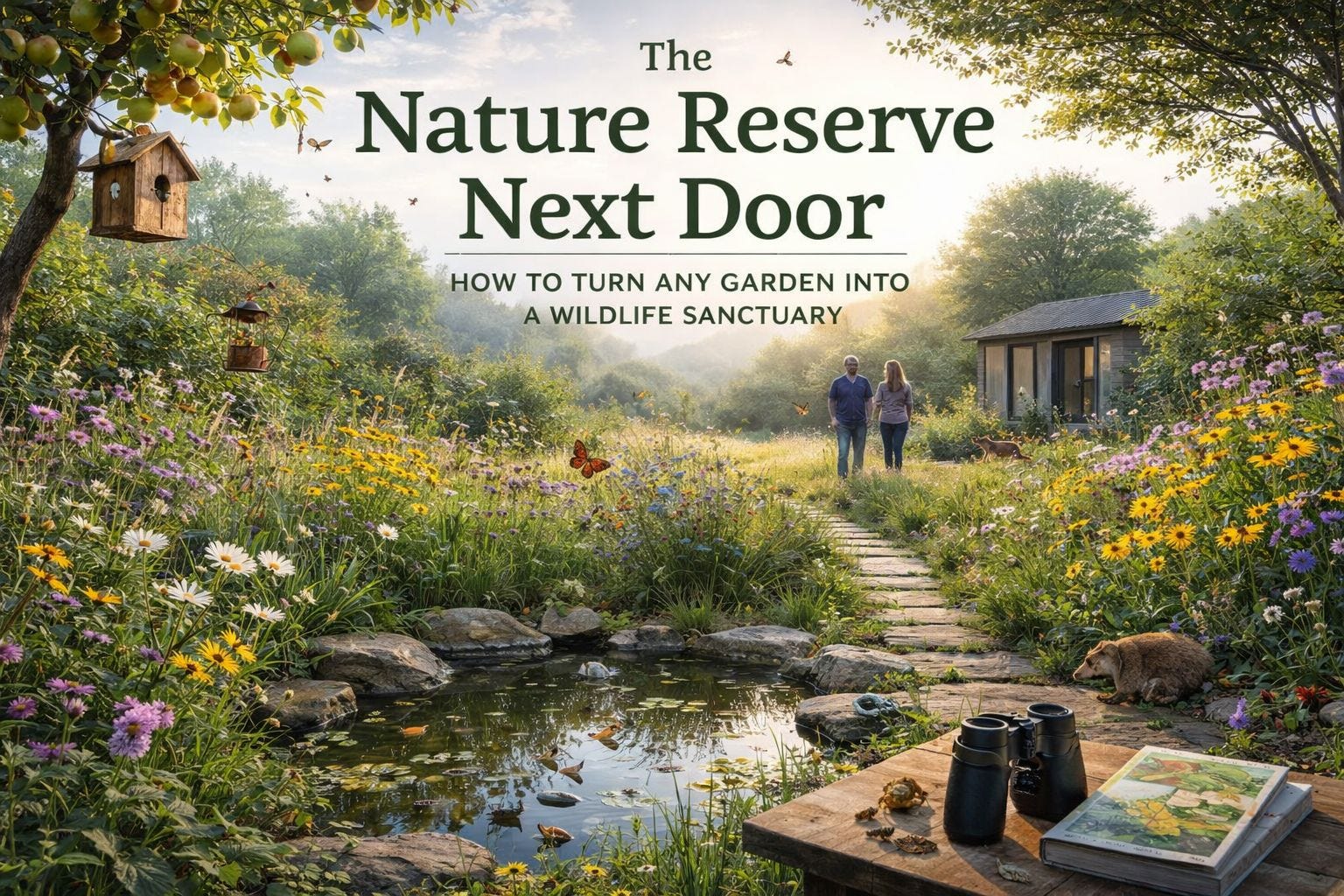
Chapter One: What Is Garden Rewilding?
A Shift in Purpose
Garden rewilding is, at heart, a shift in purpose. Traditional garden design in Britain and much of the temperate world often prioritised neatness, short lawns, and curated ornamentals — a vision rooted in eighteenth-century landscape aesthetics that prized control, symmetry, and the mastery of nature. Grass was to be clipped into submission; hedges chopped into geometry; wildflowers dismissed as weeds. The result was beautiful in a particular, limited way. But it was, ecologically speaking, close to a desert.
Rewilding, and its close cousin wildlife gardening, moves the purpose in a different direction entirely. Here, the primary metric is not tidiness — it is habitats, ecological processes, and bio-abundance. The question is not ‘does this look neat?’ but ‘does this support life?’ And crucially: ‘does it support life while still making space for human joy, beauty, and use?’ Because a rewilded garden that humans cannot enjoy or access will not remain a rewilded garden for long.
Rewilding at Scale — and at Garden Scale
At landscape and national scales, the definition of rewilding is well-established. Rewilding Britain describes it as restoring ecosystems ‘to the point where nature is allowed to take care of itself’, including reinstating natural processes and sometimes missing species so that ecosystems can become more self-willed and resilient. The International Union for Conservation of Nature emphasises that rewilding is nature-led and human-enabled, focused on recovering ecological processes, interactions, and conditions.
At garden scale, the vocabulary shifts. You are not reintroducing wolves or bison. You are not managing thousands of hectares of upland heath or coastal floodplain. But you are restoring the foundations that make landscapes feel alive: flowering and seeding cycles, decomposition, soil recovery, water movement, predation (spiders eating aphids; birds eating caterpillars; bats eating moths), seasonal refuge, and crucially — connectivity between habitats. A rewilded garden that is isolated from other habitats is an ecological island. A rewilded garden that connects to a rewilded neighbour’s garden, and theirs to another, and another — that becomes a landscape.
Wildlife Gardening vs. Rewilding: What’s the Difference?
The distinction between ‘wildlife gardening’ and ‘garden rewilding’ is often debated. In practice, the two overlap so substantially that the argument is more philosophical than practical. Wildlife gardening tends to sound more hands-on — you plant, you provide, you manage. Rewilding tends to sound more process-led — you step back, you reduce interventions, you let systems self-organise. In a typical small or medium garden, the best results come from a blend of both philosophies: intentional planting and design choices that then give way to ecological processes, succession, and self-management wherever possible.
Think of it this way: you choose where the pond goes (wildlife gardening), but you let it colonise naturally rather than buying species from a garden centre (rewilding). You select native meadow seed appropriate to your soil (wildlife gardening), but you reduce fertility deliberately and then let the grass-wildflower balance find its own equilibrium over years (rewilding). You plant a native hawthorn hedge (wildlife gardening), but you cut it on a rotation that mimics traditional layering and allows fruiting, nesting, and structural complexity to develop (rewilding). The border between the two approaches dissolves in practice, and this guide moves freely across it.
